Practicalities:
The 4 for price of 3 must be negotiated at time of registration. Please email us for discussion: [email protected]
This masterclass is designed for experienced doctors and nurses who are interested in updating or developing their skills in palliative care. Topics are selected from the Oxford Advanced Course in Pain and Symptom Management 2025. The teaching materials have been updated with new publications and the latest developments in the field, and a case-based, face-to-face teaching approach is at the core of this masterclass. The masterclass will also feature the 2026 Marymount Lecture, titled 'Problematic Opioid Use' by Dr Jessica Lee.
Further details about the speakers, lectures, venue, and course aims are available in the dropdown menus below. For the 2026 programme, please click: LINK to view
Collaboration:
The Oxford Centre for Education and Research in Palliative Care is proud to collaborate with Marymount University Hospice to present this masterclass. The course will be facilitated by Dr Mary Miller (Oxford) and Dr Fiona Kiely (Marymount).
Feedback:
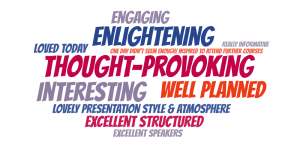
Word cloud from the first masterclass of the year - from delegates attending in Strathcarron, Scotland:
' The hard work in preparing for the masterclass certainly paid off as I learned a huge amount from it and keep going back to your slides as they are really helpful resources. We use Prucalopride with success, stimulated the salivary glands as our first step in managing dry mouth and used the resources on hepatic failure for two new referrals to the service.'
Location: Face to face
CPD Credits: 5 CPD points expected
+ Venue
Marymount University Hospital & Hospice,
Curraheen,
County Cork,
T12 A710
+ Speakers
Dr Fiona Kiely, MB BAO BCH BMedSc FRCPI MICGP - Consultant in Palliative Medicine at Marymount University Hospital & Hospice and Cork University Hospital, Cork, Ireland and Senior Clinical Lecturer, University College Cork, Ireland.
Dr Kiely qualified from University College Cork in 2002. Following a year working in general medicine in Princess Alexandra Hospital, Brisbane, Australia, Fiona trained and worked as a general practitioner in Ireland before completing Higher Specialist Training in Palliative Medicine with the Royal College of Physicians of Ireland in 2016. She holds diplomas in Medicine of Elderly, Child Health, Clinical Psychiatry and Clinical Dermatology and is a PhD candidate at the International Observatory of End of Life Care, Division of Health Research Lancaster University, United Kingdom. Research interests include symptom experience, complex communication, telehealth and artificial intelligence in palliative care.
Dr Mary Miller - Consultant in Palliative Medicine, Sobell House, Honorary Senior Clinical Lecturer in Palliative Medicine, University of Oxford, Director OxCERPC (Oxford Centre for education and research in palliative care) and Clinical Lead for NACEL
Dr Miller qualified from University College Cork, Ireland in 1988. She trained and worked in palliative medicine in Ireland, Sweden and the UK and has been a consultant in palliative medicine in Oxford since 1998. Dr Miller has a strong interest in education; completing a Diploma in Learning and Teaching at Oxford University 2005, was Training Programme Director and Regional Specialty Advisor (2002 – 2008) and has led the Oxford Advanced Courses in Pain and Symptom Management since 2005. She is an elected member of the Education Committee of the Association of Palliative Medicine and joint lead of the postgraduate education special interest forum. Since the inception of OxCERPC in 2017, Dr Miller and the team are focusing on building an exciting portfolio of courses, building research readiness and reaching out to practitioners across the globe.
Dr Jessica Lee - Clinical Fellow telehealth, Marymount Hospice, Republic of Ireland
Dr Jessica Lee trained in palliative medicine in Ireland before taking up a Clinical Fellow post in Marymount University Hospice. Dr Lee has been appointed to a substantive consultant post in Marymount. Dr Lee led the research project ‘A transatlantic study to explore the attitudes of palliative care physicians regarding the identification of problematic opioid use among patients with advanced cancer’ with the principal investigators, Dr Fiona Kiely and Dr Jenny Lau. Problematic opioid use is a term which describes a myriad of dysfunctional behaviours in relation to opioid use. There is growing evidence illustrating that problematic opioid use poses a more significant risk to patients with advanced cancer than previously believed and the mitigation of opioid related risk in the palliative care context has been highlighted as an important area for future research. A number of risk factors for the development of problematic opioid use in the palliative care patient cohort have been identified by expert consensus. It is unclear, however, if or how palliative care physicians interpret and utilise these factors in their clinical practice and whether cultural or geographical contexts influence their attitudes towards problematic opioid use. Dr Lee will present the results of the study.
+ Course Programmes
2026 Programme example:
09:00 - Coffee and registration
09:15 - Welcome and Introduction
09:25 - Nausea and vomiting (Dr Mary Miller)
Reviewing our practice and the current evidence base and considering new medications to add to our repertoire. Updating our knowledge about chemotherapy induced nausea and vomiting.
10:10 - Nonpharmacological management of breathlessness (Dr Mary Miller)
What is the evidence base for non-drug management? How does this sit alongside drug management?
10:40 - Coffee Break
11:10 - Oral health (Dr Mary Miller)
Oral hygiene for dying patients, how can we improve? Updating on the management of oral candidiasis.
11:45 - Vitamin deficiencies in our patients (Dr Mary Miller)
Is it important in dying patients? Latest on B12 deficiency from the palliative care formulary
12:15 - Lunch
13:15 - The Marymount Lecture 2026 - ‘Problematic Opioid Use’ (Dr Jessica Lee)
14:15 - Break
14:30 - Hepatic Failure Talk (Dr Mary Miller)
15:00 - Opioid induced neurotoxicity (Dr Mary Miller)
What is opioid induced neurotoxicity? Is it common in palliative care? Do we need to change our practice?
15:30 - Final remarks and feedback
15:45 -Close of day
+ Course Aims
Knowledge to inform your practice
Resources from which to continue learning and adapt that learning in practice
A means of ensuring your practice compares with ‘good practice’, benchmarking against your peers
Stimulation, time for thinking and reflection